Class War Conservatism: And Other Essays by Ralph Miliband
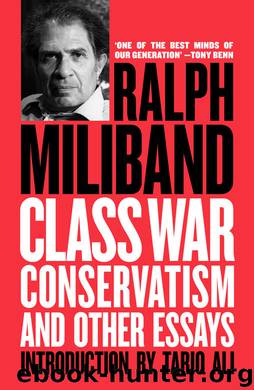
Author:Ralph Miliband [Miliband, Ralph]
Language: eng
Format: azw3, epub
Publisher: Verso Books
Published: 2015-09-08T04:00:00+00:00
* Let History Judge. The Origins and Consequences of Stalinism, London 1972; De la Démocratie Socialiste, Paris 1972 (English translation On Socialist Democracy, Nottingham 1977). References to Let History Judge are indicated by the abbreviation LHJ, and to De la Démocratie Socialiste by the abbreviation DS.
1. In this Preface to De la Démocratie Socialiste, Georges Haupt suggests that ‘Medvedev’s philosophy is that of a moralist in Leninist clothes whose mind recalls tha of R.W. (sic) Tawney, one of the Christian theoreticians of British socialism in the 20th century’ (p.30). This is inaccurate. There may be argument as to what kind of a Marxist Medvedev is; but he proclaims himself as one and his thinking is miles apart from Tawney’s.
2. These conditions may also help to account for the blots which sometimes mar his work—see, for instance, his misrepresentation of Isaac Deutscher’s work (LHJ, pp.559-60).
3. So much so that Medvedev is able to write that ‘most of our students and senior school-children know nothing of Stalin’s crimes’ (DS, p.71). He gives many examples of the ways in which attempts have been made, particularly in recent years, to qualify the condemnation of ‘the cult of personality’ and of Stalin’s contribution to the horrors of Stalinism. It was actually possible for two historians to write in 1966 that, in the years of the terror, ‘the Party and its local organs lived their own active, autonomous life. In continuous conflict with the unhealthy tendencies engendered by the cult of personality, the genuinely Leninist principles on which the Party was founded invariably won out’ (LHJ, p.355. Italics in text).
Medvedev is also understandably and rightly bitter about the Chinese attitude of broad approval for Stalin, notwithstanding his ‘mistakes’ which are grudgingly acknowledged. For a recent example of the Chinese evaluation of Stalin, see S. Lee ‘Conversation with Premier Chou-En-Lai’, Social Praxis, 1973, Vol. 1, No. 1, in which the latter is reported as ‘evaluating’ Stalin as ‘70% good, 30% bad’ (p.6).
Nor of course is this a Chinese quirk. Many ‘anti-revisionists’, including some who are members of Communist Parties, have tended to see the defence of Stalin as part of their struggle against their party’s ‘revisionism’. The notion is grotesque, but not particularly surprising; and it emphazises the need to continue the exposure of the reality of Stalinism.
4. As early as 1933, the Leningrad Branch of the Communist Academy was able to report that it had rooted out ‘Trotskyism, Luxemburgism and Menshevism, not only on the historical but also on the economic, agrarian, literary and other fronts’ (LHJ, p.143). But the authors had obviously underestimated the magnitude of the task.
5. Such as the fact that the wife of Kalinin, the President of the Soviet Union, was kept in prison for seven years. In Medvedev’s words, ‘the epoch of the cult is epitomized in that situation: the country had a President whose wife was kept in a concentration camp’ (LHJ, p.349). Something like this also happened to Molotov’s wife after the war. There are endless examples of individual
Download
Class War Conservatism: And Other Essays by Ralph Miliband.epub
This site does not store any files on its server. We only index and link to content provided by other sites. Please contact the content providers to delete copyright contents if any and email us, we'll remove relevant links or contents immediately.
| Anthropology | Archaeology |
| Philosophy | Politics & Government |
| Social Sciences | Sociology |
| Women's Studies |
The Secret History by Donna Tartt(19028)
The Social Justice Warrior Handbook by Lisa De Pasquale(12182)
Thirteen Reasons Why by Jay Asher(8883)
This Is How You Lose Her by Junot Diaz(6872)
Weapons of Math Destruction by Cathy O'Neil(6261)
Zero to One by Peter Thiel(5782)
Beartown by Fredrik Backman(5734)
The Myth of the Strong Leader by Archie Brown(5491)
The Fire Next Time by James Baldwin(5423)
How Democracies Die by Steven Levitsky & Daniel Ziblatt(5211)
Promise Me, Dad by Joe Biden(5139)
Stone's Rules by Roger Stone(5079)
A Higher Loyalty: Truth, Lies, and Leadership by James Comey(4946)
100 Deadly Skills by Clint Emerson(4911)
Rise and Kill First by Ronen Bergman(4775)
Secrecy World by Jake Bernstein(4738)
The David Icke Guide to the Global Conspiracy (and how to end it) by David Icke(4696)
The Farm by Tom Rob Smith(4500)
The Doomsday Machine by Daniel Ellsberg(4481)
